Student Growth: Enisa

Enisa is a 10–year old girl with a diagnosis of Autism Spectrum Disorder. She currently communicates primarily using 3–4 words verbally and supported communication to request preferred items or activities, make brief comments, and answer familiar questions. She benefits from visual supports, structured routines, and consistent language models across settings. Enisa is currently able to express basic wants and needs using short phrases (e.g., "want Peppa Pig", "it's my turn", "go bathroom", "I want ___") and can answer simple "what"/ "who"/"where" and "yes"/"no" questions when calm and supported. However, she has significant difficulty expressing internal states, such as discomfort, frustration, emotional distress, or when something is wrong. When she is unable to communicate these needs effectively, she frequently engages in behaviors that may be harmful to herself or others, rather than using language to seek help or request a break. Expressive language is inconsistent across environments and decreases during non-preferred tasks, transitions, or sensory overload. Receptively, Enisa demonstrates understanding of simple, familiar directions and routine-based language when paired with visual cues and gestures. She can follow one-step directions and respond to basic questions when provided with adequate processing time.
Annual Goal 1: Enisa will label a pronoun (she, he, they) + action + object in response to "What is ____ doing?" when looking at a picture or after listening to a 1-2 sentence story in 8/10 trials as measured by data collection and teacher/provider observations
Annual Goal 2: During structured/unstructured activities, Enisa will use 3-5 word utterances for a variety of pragmatic functions (e.g., greeting, requesting, labeling, commenting and/or describing) in 4/5 trials over three consecutive sessions in 4/5 trials over three consecutive sessions as measured by data collection and teacher/provider observations
Annual Goal 1: Enisa will maintain social interactions with classroom peers/adults for at least 3 conversational exchanges by commenting and/or asking questions during structured/unstructured tasks in 4/5 trials over three consecutive sessions in 4/5 trials over three consecutive sessions as measured by data collection and teacher/provider observations
Annual Goal 2: Enisa will respond to factual "What", "Who" and "Where" questions by verbalizing when presented with a short story in 8/10 trials as measured by data collection and teacher/provider observations
Annual Goal 1: Enisa will improve problem-solving skills by identifying at least two possible solutions to a conflict when presented with different scenarios in 4/5 trials over three consecutive sessions as measured by data collection and teacher/provider observations
Annual Goal 2: Enisa will describe pictures/scenes/short stories by formulating grammatically correct phrases/sentences to describe objects/pictures via subject + verb + adjective + object (i.e., "I see a blue ball") in 8/10 trials as measured by data collection and teacher/provider observations
Annual Goal 1: When experiencing frustration, discomfort, or a problem, Enisa will independently use functional expressive language to communicate what is wrong (e.g., “I need help”, “please stop”, “I’m feeling mad” , “___ is bothering me”) using 3–5 word phrases in 4 out of 5 opportunities across school settings as measured by data collection and staff observation
Annual Goal 2: Enisa will increase expressive language complexity by producing 4–6 word phrases or simple sentences to request, comment, and/or respond to questions (e.g., “I need help with this,” “I don’t like the noise,” “I am finished with my work”) in 8/10 opportunities as measured by data collection and teacher/provider observations
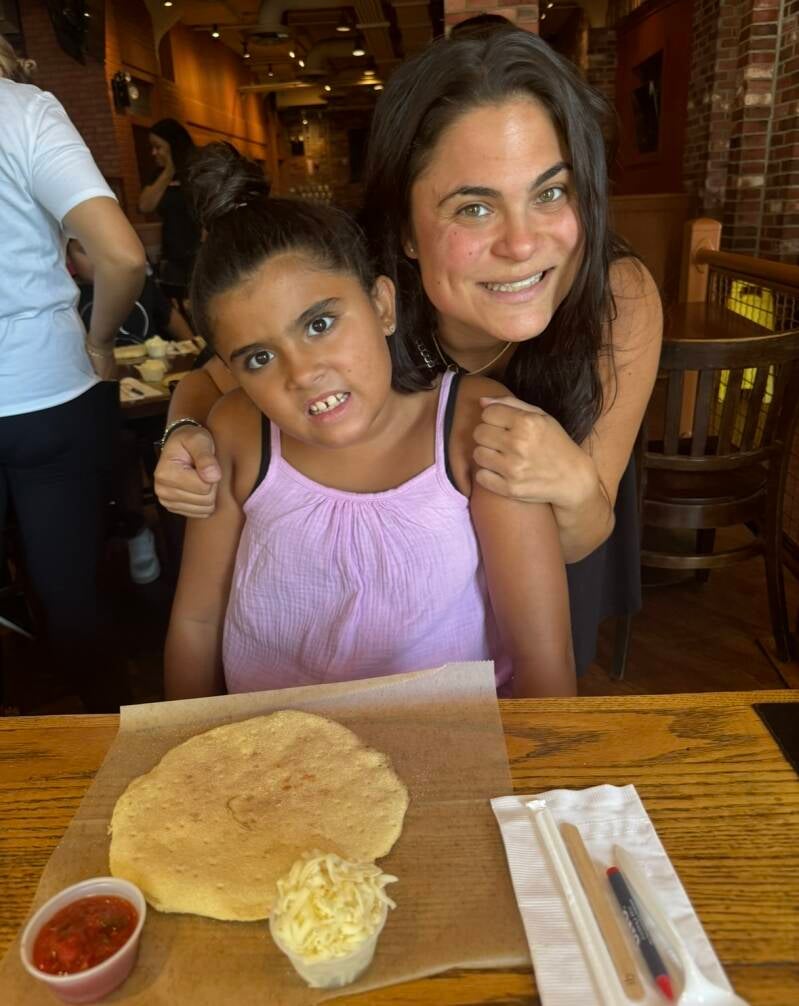
When I began working with Enisa, she primarily communicated using 2–3 word phrases to express basic wants, needs, and simple responses. While functional, her expressive language was not developed enough to convey internal states such as discomfort, hunger, pain, frustration, or illness. Consequently, she often exhibited severe and unpredictable aggression toward herself and others. These behaviors were difficult to foresee and, particularly early in intervention, challenging to de-escalate.
Intervention targeted functional communication, emotional regulation, and access to alternative supports. I provided explicit instruction in functional language, modeled and expanded Enisa’s speech, and used visual and structured supports to reduce anxiety and increase predictability. When it became clear that verbal language was not reliable during moments of dysregulation, I advocated for the introduction of a static display speech-generating device (SGD) to ensure she had consistent access to communication.

As her skills developed, Enisa increasingly used verbal language and her SGD to express internal states, regulate emotions with support, transition more flexibly, and participate more successfully in activities and peer interactions. Most notably, aggressive behaviors decreased as her ability to communicate effectively increased, allowing her to advocate for herself in safer and more meaningful ways.


As Enisa prepares to graduate this year, I conducted a comprehensive review of her progress and readiness for a less restrictive service model. Given her significant growth in communication skills, improved regulation, and increased peer engagement, I recommended transitioning her mandate from 3x30:1 to a combination of 2x30:1 and 1x30:2. This shift reflects a deliberate move toward placing Enisa in the least restrictive environment to promote generalization of skills across settings and communication partners. Incorporating group therapy supports the continued development of higher-level language, social problem-solving, and flexible communication, allowing her skills to evolve beyond foundational needs and into more complex, peer-based interactions.
Create Your Own Website With Webador